the evidence for doing
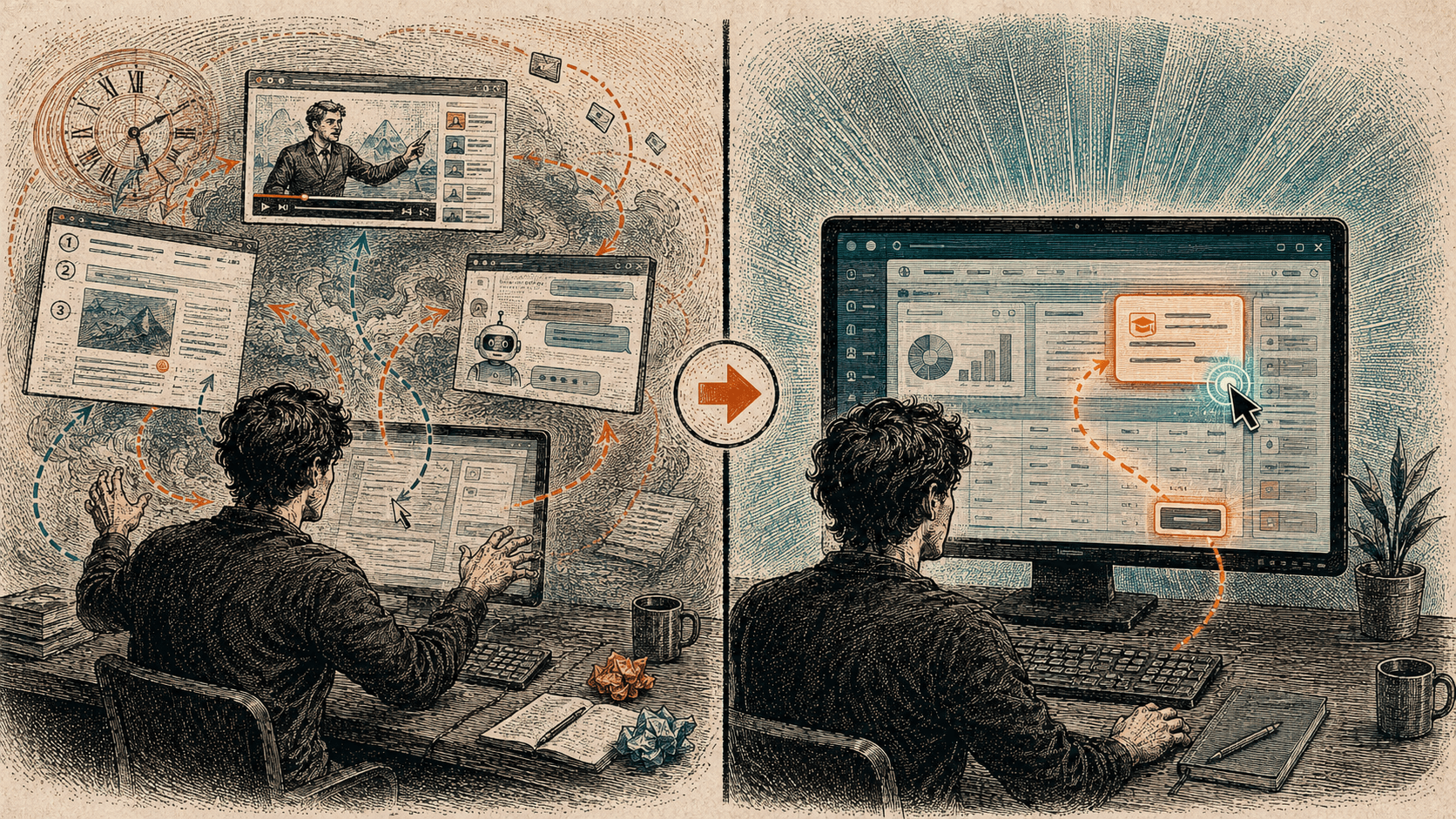
watching feels like progress. forty years of studies say the skill only shows up when you do the thing.
by Timur Latipov · · 7 min read
the short version
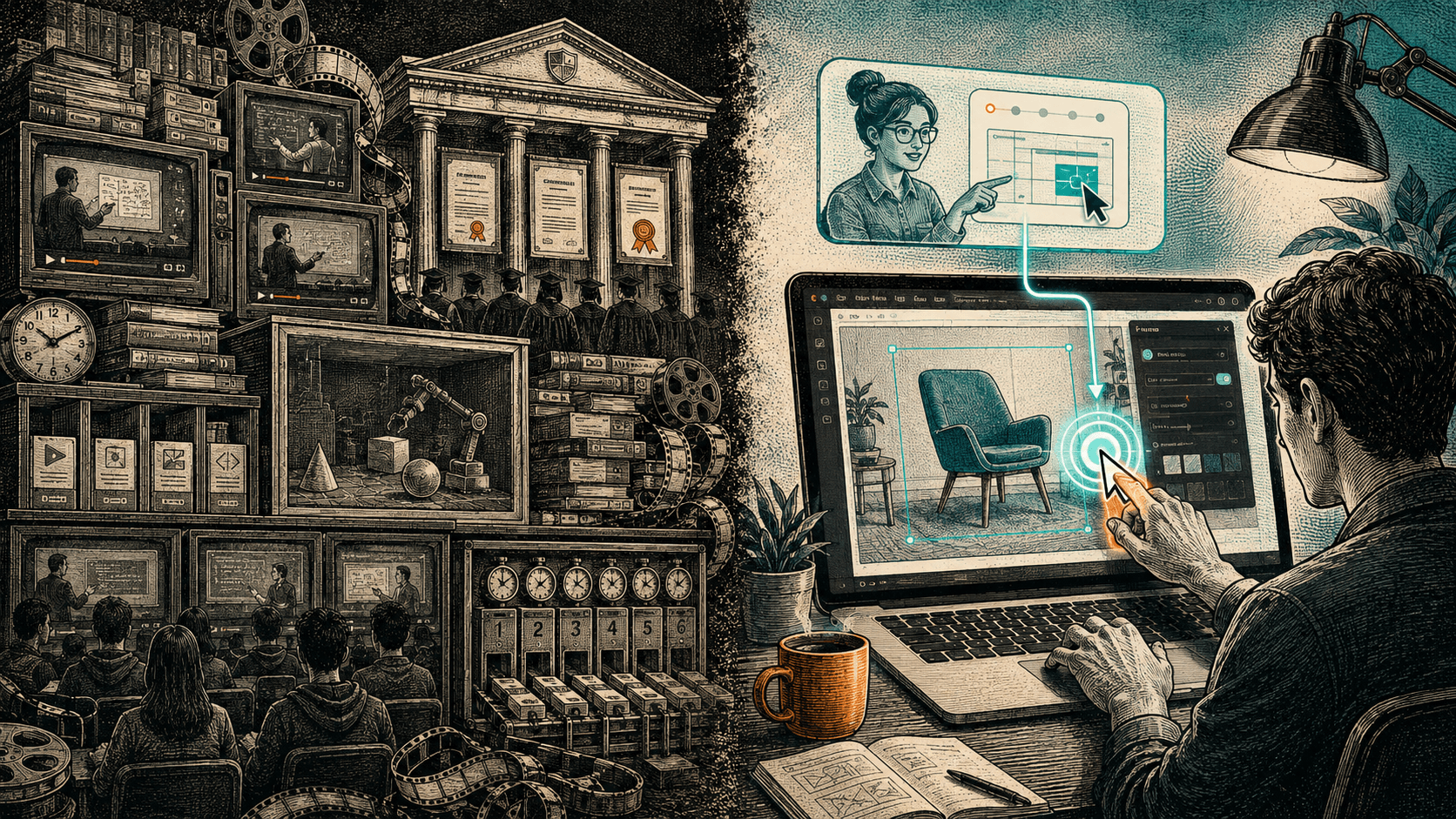
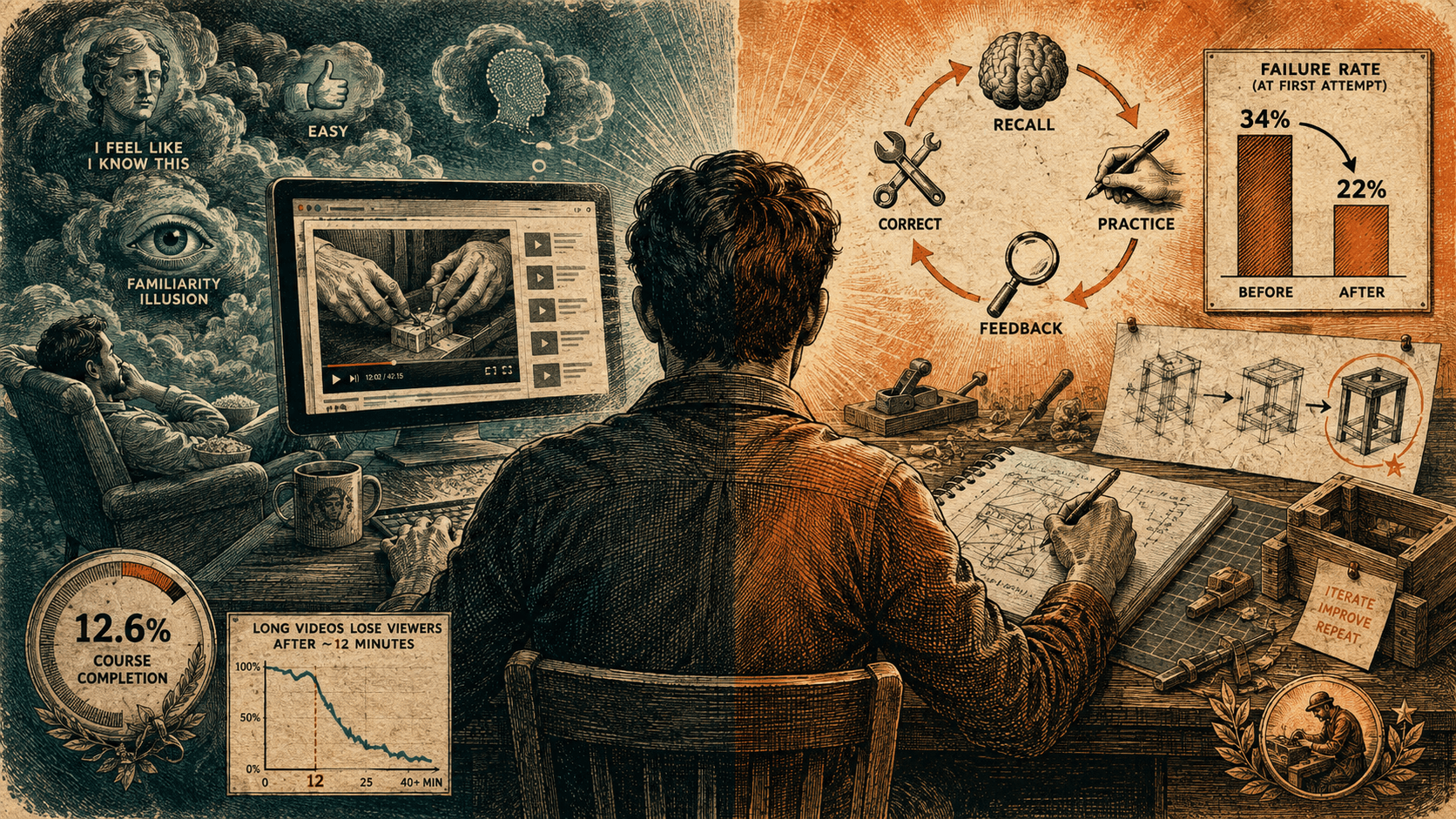
Watching a tutorial builds a feeling of understanding that doesn't survive the moment you try the thing yourself. That gap has a name in the research - the fluency illusion - and a pile of evidence behind it. Across 221 studied online courses the median completion rate was 12.6%, and on the biggest open platforms it has run lower still, nearer one in twenty. Most people don't even finish the video: past about twelve minutes, fewer than half watch to the end.
What works is doing. A meta-analysis of 225 studies found that active learning cut failure rates from about 34% to 22% and raised exam scores by roughly half a standard deviation over lecturing. Trying to recall something you half-know beats re-watching it, even though re-watching feels easier and surer. The rule that falls out is simple: put the help inside the doing, not before it.
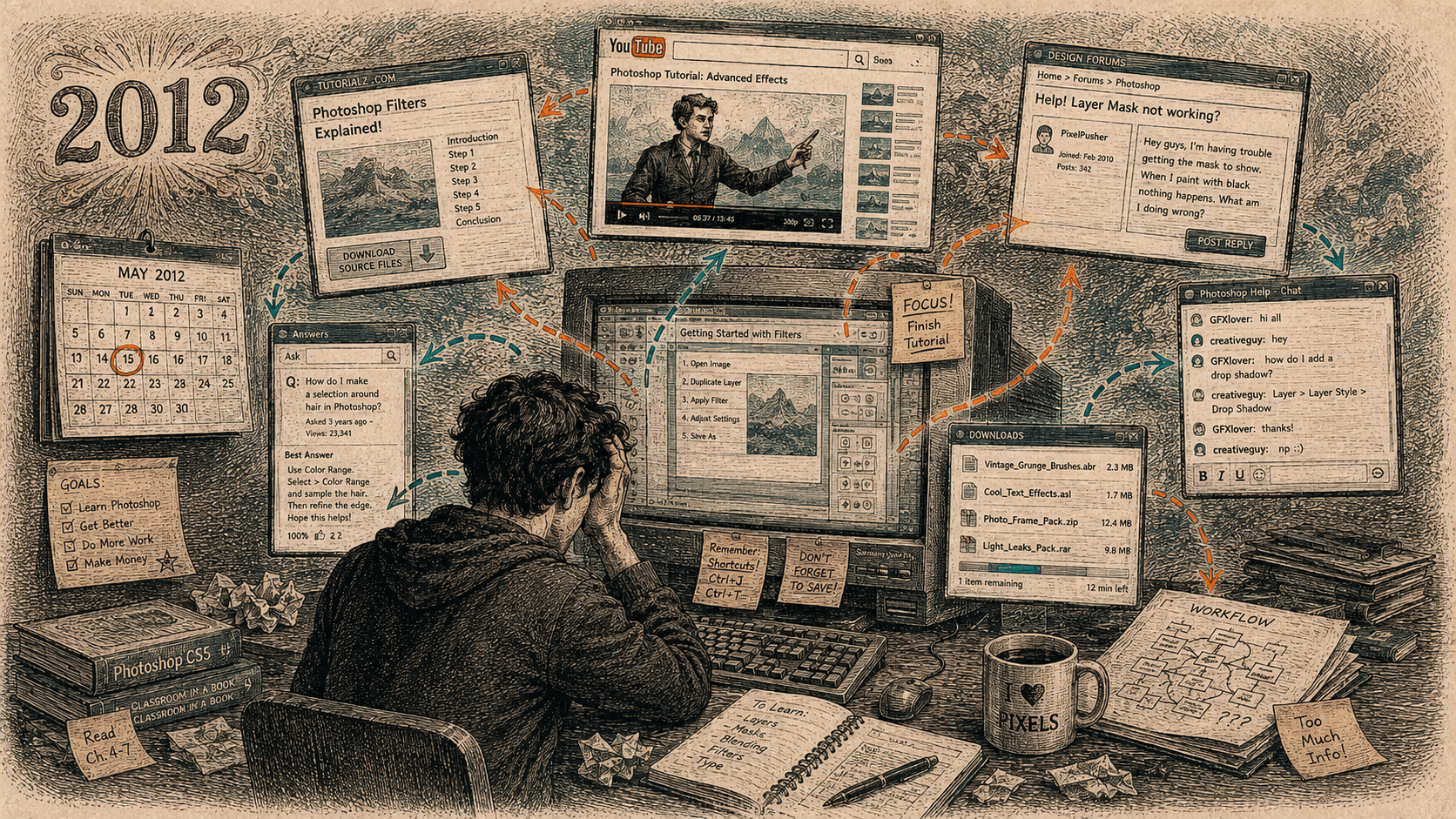
You can watch a forty-minute tutorial, nod the whole way through, and be unable to do the thing ten minutes later. This is not a personal failing. It's one of the most replicated findings in the science of learning, and it has a mechanism worth knowing.
The confusion sits between two things that feel the same from the inside: the feeling of understanding, and the skill itself. Watching is very good at producing the first and nearly useless at producing the second, and almost everything that goes wrong with online learning starts there.
the feeling isn't the skill
When you re-read a page or re-watch a clip, it gets easier to follow each time, and your brain reads that ease as "I know this." Psychologists call it the fluency illusion: familiarity feels like mastery and isn't. Koriat and Bjork showed people will confidently predict they'll remember things they're about to forget, precisely because the material felt smooth while they studied it.
The deeper finding, from Robert Bjork's work, is that this runs backwards. The conditions that make learning feel hard - recalling something from memory instead of looking it up, spacing practice out, mixing problems together - are the ones that make it stick. The conditions that feel smooth, like re-watching, mostly don't. Bjork calls the good ones "desirable difficulties," and the cruel part is that people rate the effortful method as worse even after it's demonstrably taught them more.
the numbers on watching
Start with whether people even finish. Katy Jordan's dataset of 221 online courses put the median completion rate at 12.6%, ranging from under 1% to about half. The first year of HarvardX and MITx courses saw roughly 5% of registrants finish - that open-platform end, nearer one in twenty than one in ten, is where the familiar "almost nobody finishes" line comes from, while the 12.6% is the median once the smaller, more committed courses are counted too. The usual read is that people are lazy or busy. I don't buy it - the same people finish games far longer and harder than any course. Something about the format lets go of them.
And they let go early. Guo, Kim and Rubin looked at 6.9 million video-watching sessions across edX courses and found engagement falls off after about six minutes; for videos past roughly twelve minutes, fewer than half of viewers reach the end. So a lot of "I watched the tutorial" is really "I watched the first third of it," and even the part that got watched was watched, not done.
None of this means watching is worthless. For a beginner staring at a blank task, studying a worked example beats flailing at it unguided - that's a real, measured effect. Watching gives you the shape of the thing. It just can't be the whole thing, and it can never be the part where you get corrected.
what actually moves
The cleanest evidence is a 2014 meta-analysis by Scott Freeman and colleagues covering 225 studies of college STEM teaching. Where classes shifted from straight lecturing to active learning - students doing something rather than only receiving - exam scores rose by about half a standard deviation and failure rates dropped from roughly 34% to 22%. Put plainly, students in the lecture-only sections were about one and a half times more likely to fail.
Underneath that sits the testing effect. Roediger and Karpicke showed that trying to pull something back out of your head teaches you more than putting it back in by re-reading. The catch is the giveaway: the re-readers felt more confident and remembered less. In this corner of the mind, confidence and learning point in different directions.
Even a co-founder of Coursera has made the same point: Daphne Koller has argued that the simple act of being asked to retrieve the material teaches far more than passively watching it does.
the honest part
The case for doing gets oversold, and the oversell is worth clearing out, because it isn't needed. Two things the internet will tell you that aren't true. First, the "learning pyramid" - we remember 10% of what we read, 90% of what we do. Those numbers are fabricated; they trace to a 1940s diagram that never had any percentages on it, and they've drifted around uncredited ever since. The direction is right and the figures are fiction, and repeating them just hands the argument to anyone who checks.
Second, the idea that one-on-one teaching makes you learn "two sigma" better, from Bloom's famous 1984 result. That gap has never been reproduced at that size; the careful modern measurements of tutoring land around a third of a standard deviation - a large, real effect, just not the legendary one.
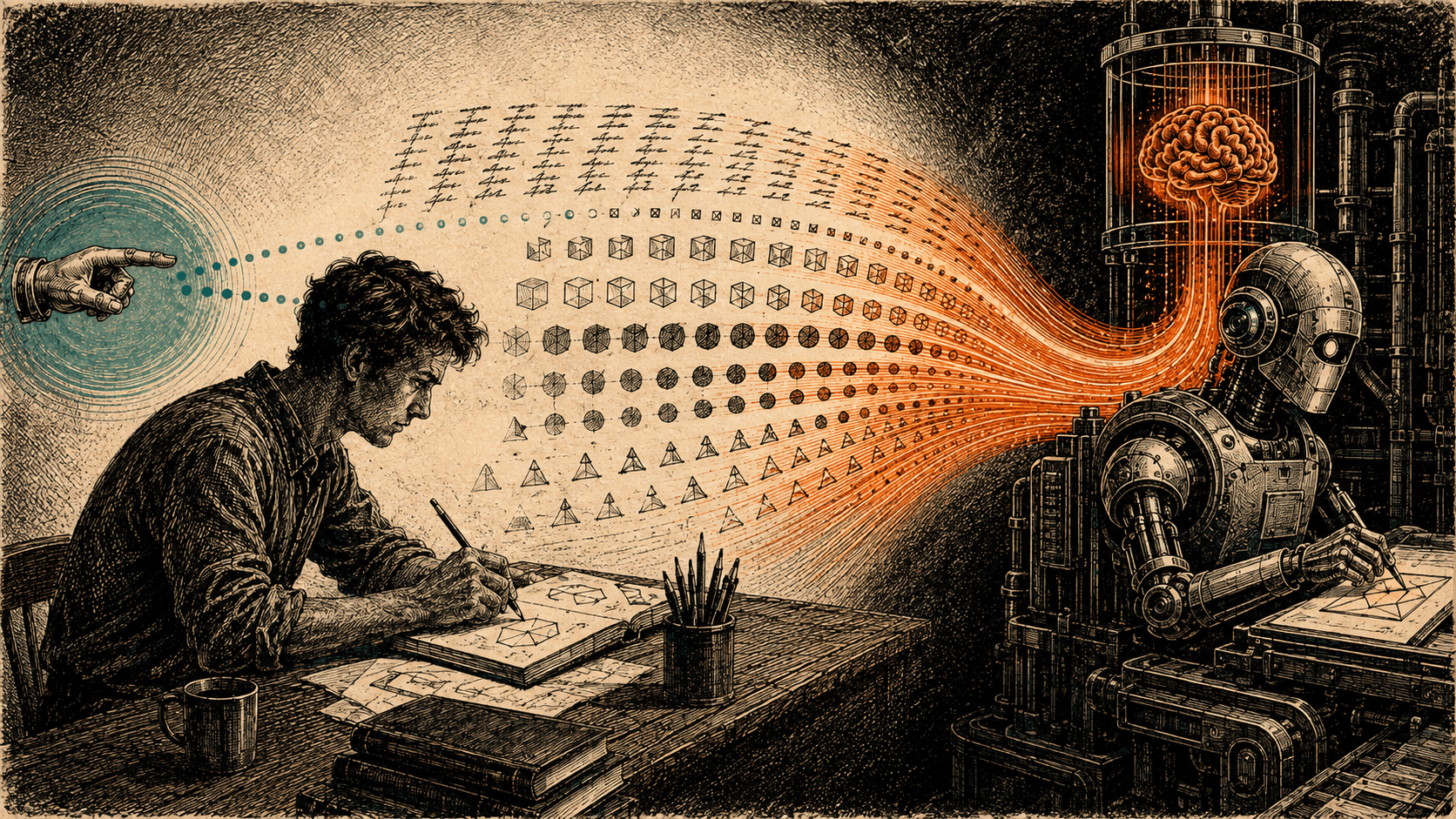
Watching builds a feeling. Doing builds the skill. The correction that turns one into the other can only happen while you're doing.
what this means for a tool
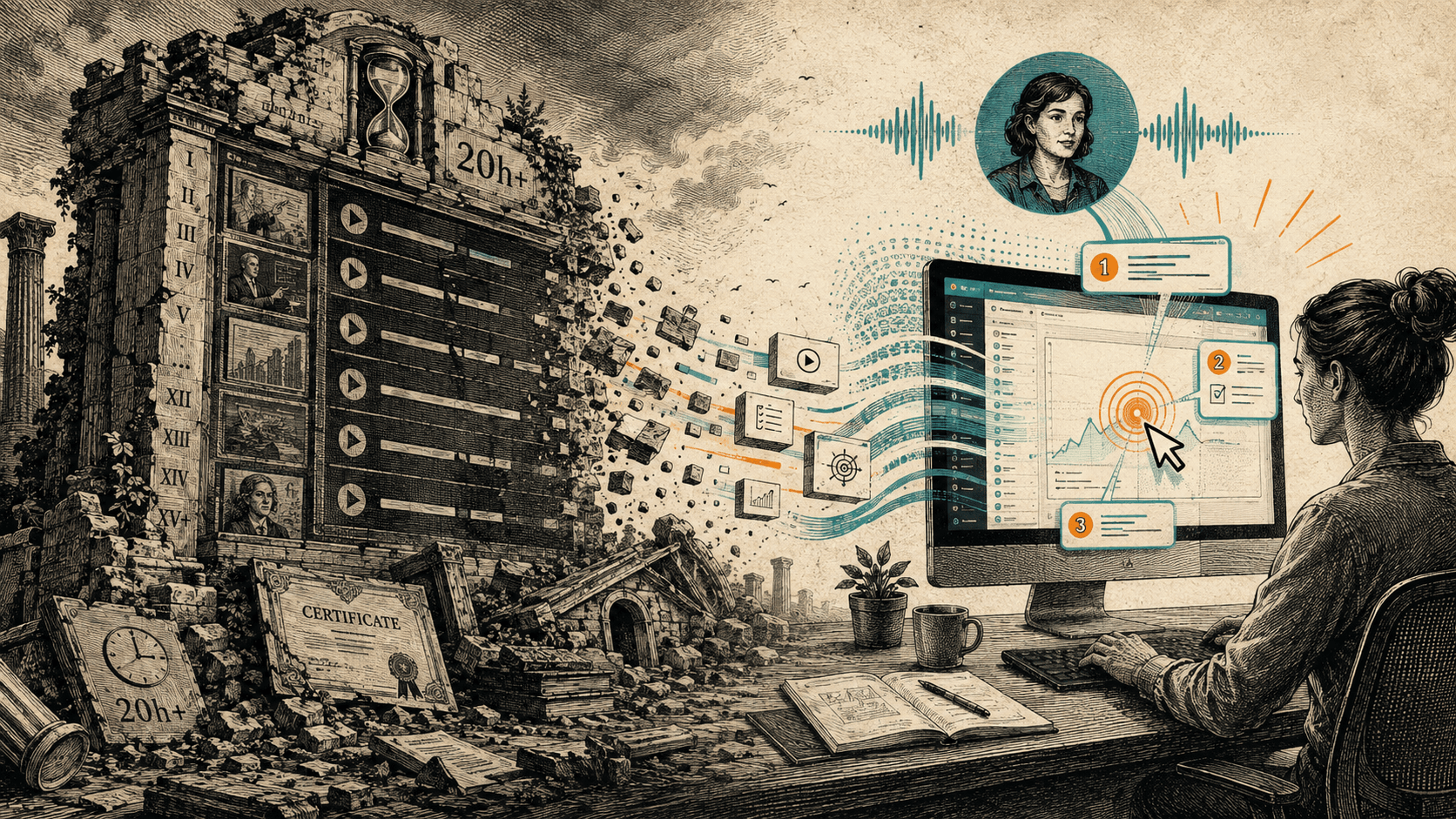
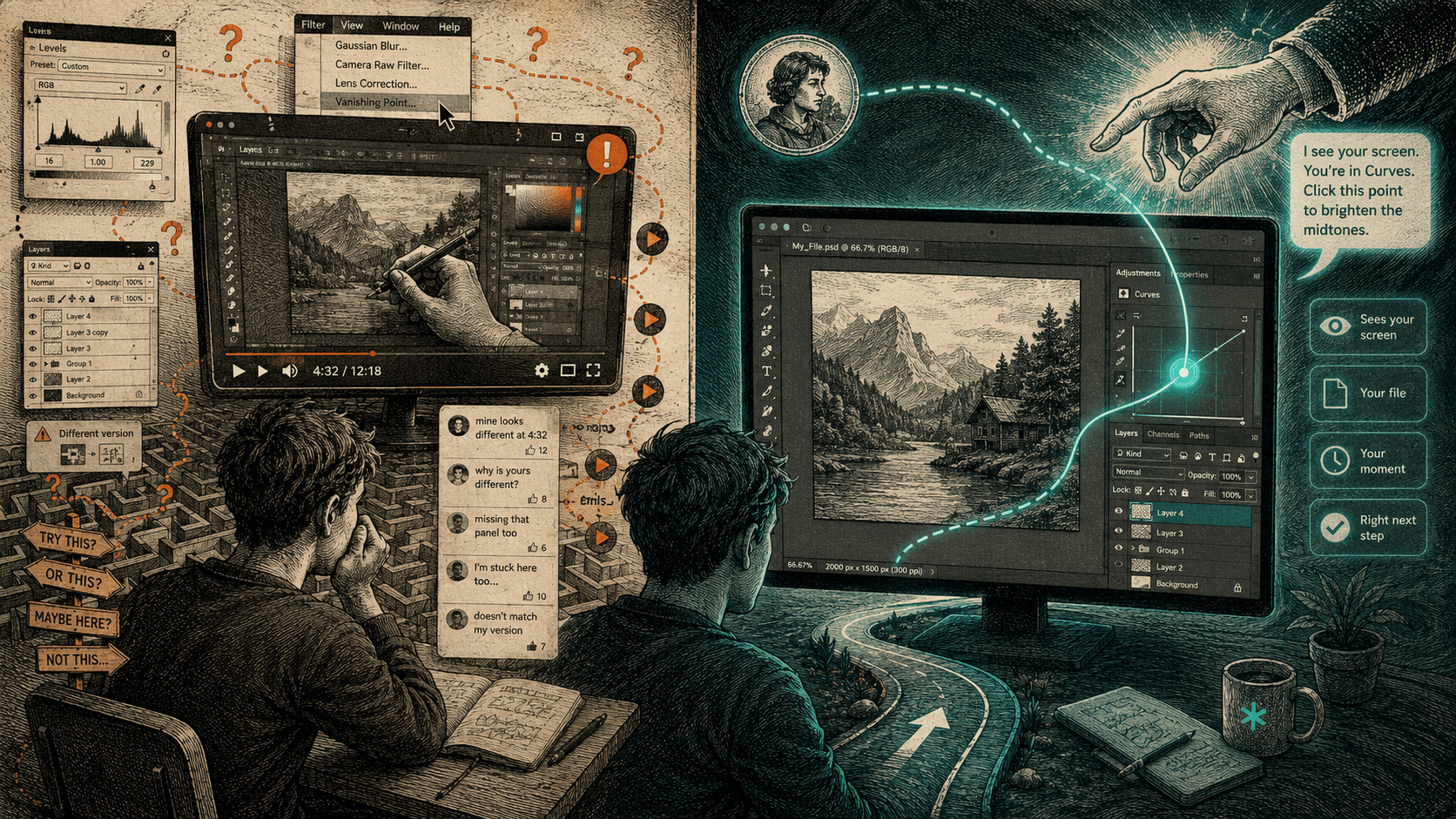
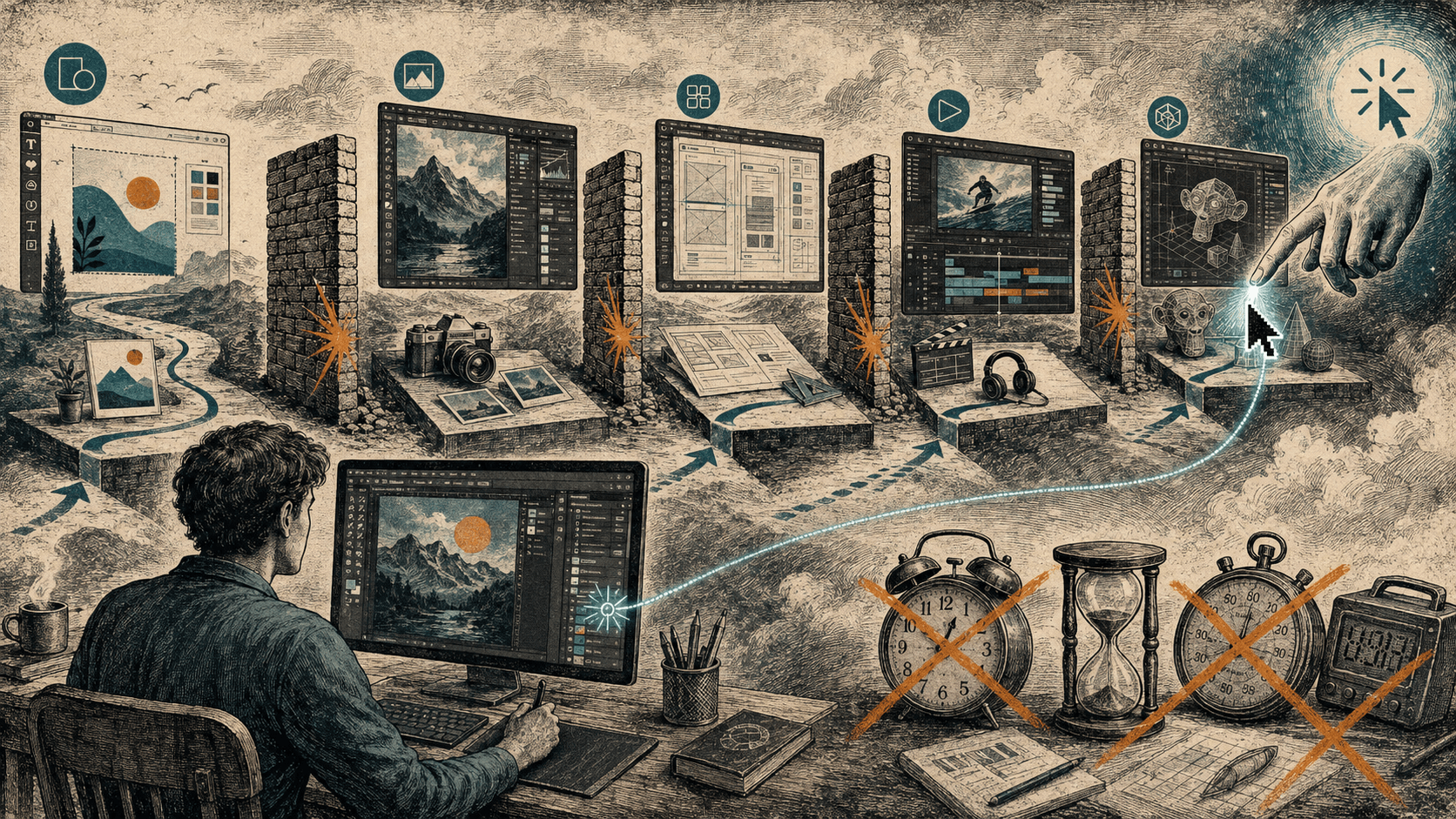
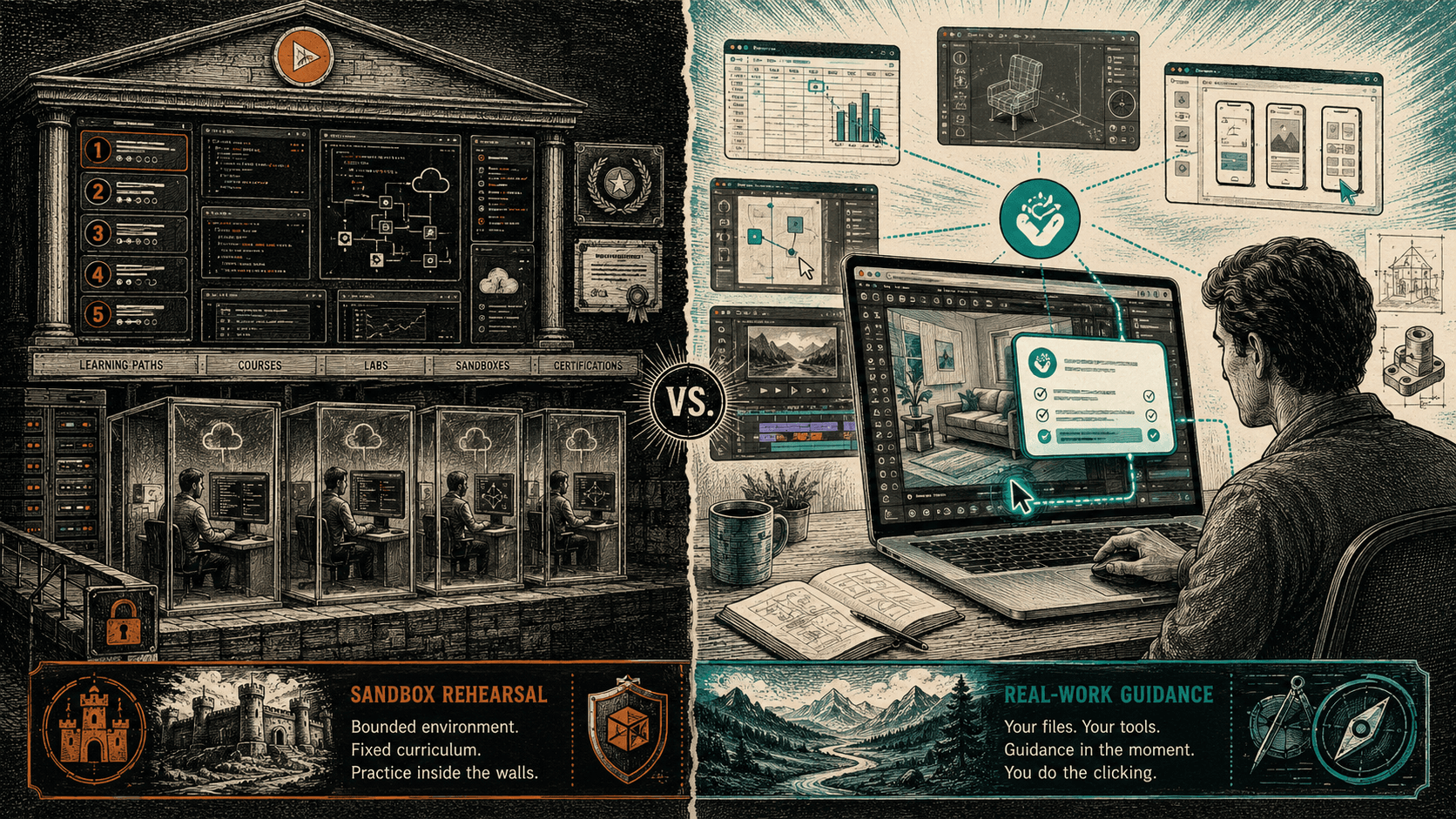
If the learning is in the doing, the help has to move there too - not a video before the task, but something next to you during it. That used to require a human tutor, which is why tutoring was at once the most effective and the least affordable thing education ever made. The reason to care about any of this now is that the expensive part just got cheap.
HeyBraza is the small version of it. You hold a key, ask out loud in the app you're actually using, and it points at the next step on your own screen. You make the clicks; the reps stay yours. That's the whole design, and the evidence above is why it's shaped that way.
what to remember
- Watching builds familiarity that the brain misreads as mastery - the fluency illusion (Koriat & Bjork).
- Across 221 studied courses the median completion rate was 12.6%; on open platforms it's nearer one in twenty.
- Past about twelve minutes, fewer than half of viewers finish an instructional video (Guo, Kim & Rubin, 2014).
- Active learning cut failure rates from about 34% to 22% across 225 studies (Freeman et al., 2014).
- Trying to recall something beats re-watching it - even though re-watching feels easier and surer (the testing effect).
- The "learning pyramid" percentages are fabricated and tutoring's real effect is about 0.3 SD, not "two sigma" - the honest case is still decisive.
questions people ask
Does watching tutorials actually work?
For getting the shape of a task, yes - studying a worked example is a real, measured help to a beginner. For building the skill, no: watching produces a feeling of understanding (the fluency illusion) that disappears the moment you try the thing yourself. The skill forms while you do it and get corrected, which is exactly where a video ends.
Why don't I remember what I watch?
Because recognition isn't memory. Re-watching makes material feel familiar, and the brain reads familiarity as "I know this." Retrieving it - trying to do or recall it without the video - is what actually lays it down, and that feels harder, so people avoid it. Confidence and learning genuinely point in different directions here.
What does the research say is the best way to learn a skill?
Do the thing, get corrected, repeat - with the difficulty kept real. A 225-study meta-analysis found active learning cut failure rates from about 34% to 22% over lecturing; the testing effect shows recall beats re-reading; and "desirable difficulties" show the effortful methods that feel worse are the ones that stick. The common thread is production, not reception.
How many people finish online courses?
Few. Across 221 courses the median completion rate was 12.6%, and the first year of HarvardX and MITx courses saw about 5% finish. Most people don't even finish the videos - past about twelve minutes, fewer than half watch to the end.
Is one-on-one tutoring really "two sigma" better?
No. Bloom's famous 1984 "2 sigma" result has never been reproduced at that size. The best modern measurements of one-to-one tutoring land around a third of a standard deviation - a large, real effect, just not the legendary one. The case for personal, corrected practice doesn't need the inflated number.
sources
stop reading. go do something - guided, on your own screen.
try for FREE today